The short answer
Pick Baserow if
The licence is the point: MIT means you can fork it, embed it, or build a product on it with no permission asked. You pay instead at the feature level — Kanban, Calendar and comments are $10 a seat even on your own server.
Pick NocoDB if
It's an internal tool and you want the whole feature set free: the community edition ships Kanban, Calendar, forms and unlimited rows with no per-seat gate. The fair-code licence only bites when you sell access to it.
| Baserow | NocoDB | |
|---|---|---|
| Self-hosted, free | Open Source Edition · unlimited rows and users | Community Edition · unlimited rows and users |
| Licence | MIT — use, embed, resell | Sustainable Use License since 9 Jan 2026 · internal use only |
| Free feature set | Grid, Gallery, Form views Kanban and Calendar need Premium | Kanban, Calendar, forms included free |
| Cloud free tier | 3,000 rows · 2 GB unlimited users | 1,000 records · 1 GB up to 3 users |
| Cloud entry tier | Premium $10/user/mo annual 50,000 rows | Plus $12/user/mo annual 50,000 records |
Checked 2 September 2026 against both vendors' pricing pages and licence documentation. Annual figures unless stated.
The licence split is the whole story
Until this year the honest answer to "Baserow or NocoDB" was "flip a coin, both are open source". On 9 January 2026 NocoDB moved from AGPL-3.0 to a Sustainable Use License built on fair-code principles. For an internal tool nothing changes: self-hosting stays free at any organisation size, with no row, user or feature caps. What now requires a commercial licence is monetising access — offering NocoDB as a hosted service, reselling it, or embedding it where your customers use it directly. Versions released before the change stay AGPL, but that is a frozen branch, not a future.
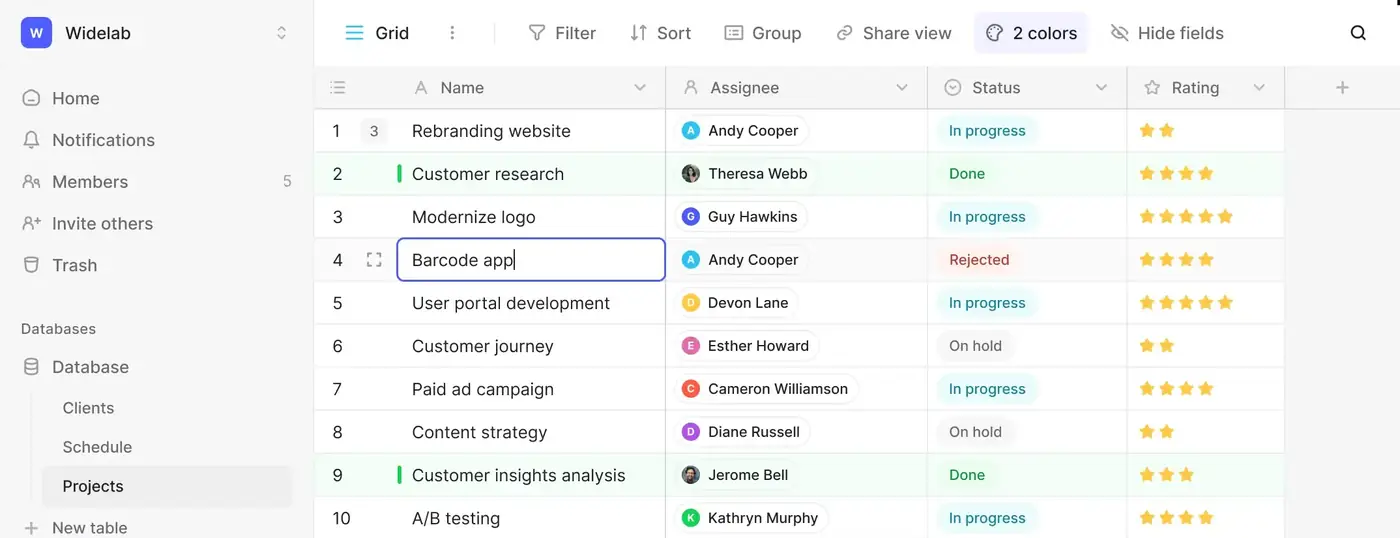
Baserow went the other way years ago and stayed there: the core is MIT — the most permissive mainstream licence there is — and the company charges for features instead. Kanban, Calendar and Timeline views, row comments and colouring, JSON and Excel export need a Premium licence at $10 per user a month even on your own hardware; role-based permissions, SSO and audit logs need Advanced at $18. The freedom is total, the free feature set is not.
What each free edition actually includes
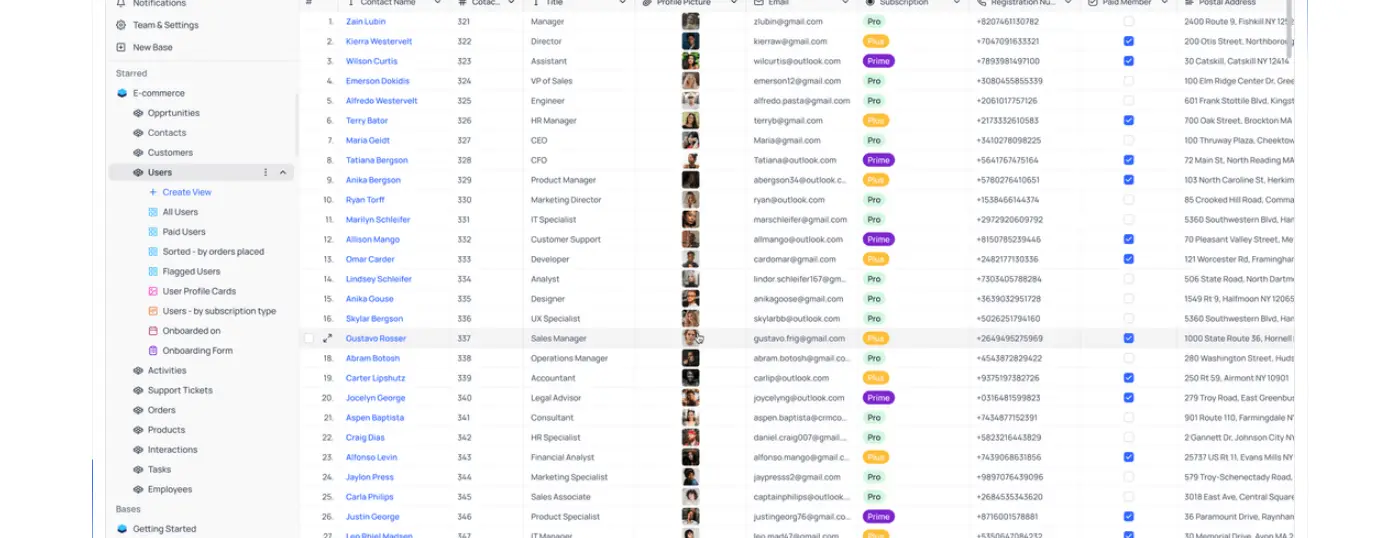
Both community editions are genuinely uncapped on the numbers that matter — rows, tables, users. The difference is the click-level features:
Read the two lists against your team and the choice usually makes itself. A five-person project board needs Kanban: free on NocoDB, $600 a year on Baserow. A compliance-bound team needs audit logs and SSO: $18 a seat on Baserow, a $45-a-seat cloud tier or a sales call on NocoDB. Neither vendor is hiding the ball; they've just drawn the paywall through different features.
The servers, since you'll be running one
NocoDB is the lighter install: the docs' minimum viable setup is 1 vCPU and 1 GB of RAM, an idle instance sits around 900 MB, and PostgreSQL plus Redis are recommended for production rather than bundled. Baserow's all-in-one image carries PostgreSQL, Redis and a Caddy proxy inside one container — more moving parts, more RAM: 2 GB to run, 4 GB for a team working concurrently, and real installs under heavy formula and webhook load report needing 8 GB before latency came back down. On a $5–7 a month VPS either fits; budget the next size up for Baserow if formulas and automations are the point.
What self-hosting actually costs
Five people, twelve months, a project tracker with a Kanban board — the honest common case.
| Baserow, self-hosted | NocoDB, self-hosted | |
|---|---|---|
| Software, 5 users | $0 core (MIT) +$600/yr for Kanban et al. (Premium seats) | $0 (SUL, internal use) |
| Server | ~$84/yr (2 vCPU / 4 GB VPS) | ~$60/yr (1–2 GB VPS) |
| Your time | ~2 h setup + ~12 h/yr | ~2 h setup + ~12 h/yr |
| Can you resell it? | yes — MIT | not without a licence |
| Year one | ~$684 + 14 hours | ~$60 + 14 hours |
Assumptions, so you can argue with them: the team actually uses Kanban, which is what puts $600 on Baserow's side of this particular table — a grid-and-forms team pays $0 there too and the totals nearly meet. VPS prices from the usual providers, September 2026. If the thing you're building will be sold to customers, the NocoDB column stops being $60 and starts being a sales call, and the comparison inverts.
Frequently asked
Is NocoDB still open source?
Not in the OSI sense any more. On 9 January 2026 NocoDB moved from AGPL-3.0 to a Sustainable Use License built on fair-code principles: internal business use stays free at any organisation size, but offering NocoDB as a hosted or managed service, reselling it, or embedding it where your customers interact with it requires a commercial licence. Versions released before the change remain AGPL.
Which is cheaper to self-host?
The servers cost about the same — a small VPS runs either. The difference is what the free edition includes: NocoDB's community edition ships Kanban, Calendar and the collaboration features free, where Baserow puts those behind a Premium licence at $10 per user a month. Baserow's answer is the licence itself: MIT, with no restrictions on what you build on it.
Which one needs a bigger server?
NocoDB runs lighter: a minimum install works in about 1 GB of RAM and idles around 900 MB. Baserow's all-in-one image bundles PostgreSQL, Redis and Caddy and wants 2 GB to run, 4 GB once several people work at once. Under heavy formula and automation load both grow — real Baserow installs report needing 8 GB.