The short answer
Pick Airtable if
Your team will never touch a server. You get the deeper integration catalogue and the interface most people have already used, on Airtable's terms only.
Pick Baserow if
You want the data on infrastructure you control, or a lower cost per seat. The Open Source Edition is MIT-licensed with no per-user fee and no row cap beyond your hardware.
| Airtable | Baserow | |
|---|---|---|
| Free plan | $0 · 1,000 records per base | cloud $0 · 3,000 rows per workspace self-hosted: unlimited |
| Entry paid tier | $20/seat/mo annual · 50,000 records ($24 billed monthly) | $10/user/mo annual · 50,000 rows ($12 billed monthly) |
| Self-hosting | not available on any plan, including Enterprise | Open Source Edition · MIT no per-user fee |
| Top published tier | Enterprise Scale · ~500,000 records custom pricing | Enterprise · 1,000,000 rows custom pricing |
| Licence | closed source | MIT (Open Source Edition) |
Checked August 2026 against both vendors' own pricing pages. Annual figures unless stated; monthly billing runs higher on both sides.
The difference that actually matters
Airtable has no self-hosted option at any plan, including Enterprise, and says it does not plan one (the ways out, and what survives them). Every base lives on Airtable's servers, under Airtable's terms, and if the company changes pricing or shuts down a feature, you have no fallback except exporting your data. Baserow ships a free, MIT-licensed Open Source Edition you can run on your own server with no per-user fee and no row cap beyond what your hardware can hold. Baserow also sells a hosted cloud version for people who want the software without the maintenance, which is where its paid tiers come in.
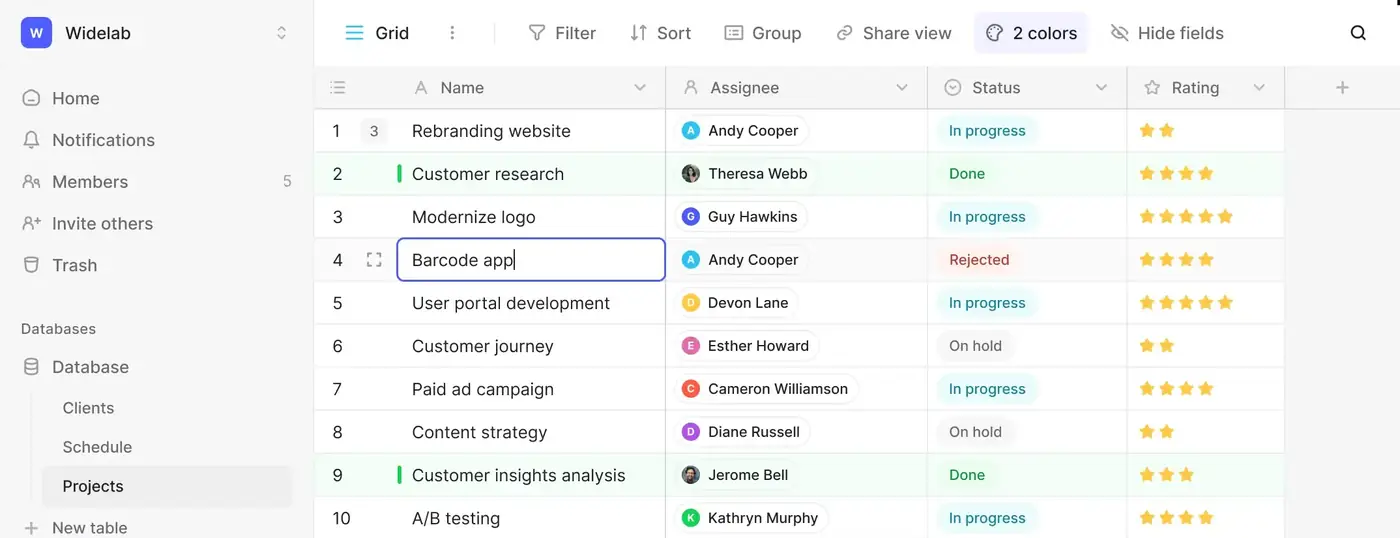
Airtable pricing
Airtable's current pricing runs four tiers, all cloud-only:
The jump from Team to Business roughly doubles the seat price. For a five-person team, Team plan billed yearly runs about $100 a month; Business runs about $225. Neither figure includes the difference in automation runs, storage, or admin controls between tiers, so check Airtable's own pricing page for the current full breakdown before committing. Figures checked against airtable.com/pricing as of August 2026; Airtable's free-tier record cap has moved before (it was 1,200 records per base until a recent cut to 1,000), so treat it as the number most likely to change again without notice.
Baserow pricing
Baserow splits into two paths: self-host it yourself for free, or let Baserow host it for you.
A team that wants Airtable-like convenience without running a server can just buy Baserow's cloud Premium plan, which lands well under Airtable's Team tier per seat. A team with the technical staff to run a Docker container gets the same core software for the cost of a small VPS, no per-seat fee at all — what that takes in practice is its own page. Figures checked against baserow.io/pricing as of August 2026.
Where each company came from
Airtable was founded in 2013 by Howie Liu, Andrew Ofstad, and Emmett Nicholas, and is based in San Francisco. It has stayed a closed, venture-backed SaaS product since launch, with no open-source release of any part of the platform.
Baserow is built and maintained by Baserow B.V., a company based in the Netherlands, and publishes its core product as open source under the MIT license alongside its hosted cloud offering. That structure, an open-source core plus a paid hosted version, is the same model used by tools like GitLab and Ghost, and it's why self-hosting is a real option rather than a footnote. Not every open-core alternative goes that far: several cap the free self-hosted edition at a handful of users and licence it above that, which turns "self-hosted" into a trial rather than an exit.
What you actually give up on each side
On Airtable: no self-hosting, ever, at any price. Your data governance is whatever Airtable's terms of service say this year. In exchange you get a more mature ecosystem, more third-party integrations, and an interface millions of people already know.
On Baserow: fewer built-in integrations than Airtable, a smaller template library, and if you self-host, you're the one applying security patches and backups. In exchange you get to own the software outright, run it on hardware you control, and never pay a per-seat fee that scales against you as the team grows.
Frequently asked
Can I self-host Airtable?
No. Airtable is a closed, cloud-only service with no self-hosted option at any plan tier. Your data lives on Airtable's servers.
Is Baserow really free?
The self-hosted Open Source Edition is free under the MIT license, with no row or user caps beyond what your own server can handle. Baserow's cloud version, where the company hosts it for you, has a free tier capped at 3,000 rows per workspace, then paid tiers starting at $10 per user a month billed yearly.
Which one has a bigger row limit?
On Airtable's Free plan, records are capped per base rather than by a simple row count tied to storage. Baserow's cloud Free plan caps at 3,000 rows per workspace. Self-hosted Baserow has no built-in row cap; the limit becomes your server's storage and memory.
What self-hosting actually costs
Licence price is the number both vendors publish, and it is the one that decides least. Here is a five-person team, twelve months, with the server and the hours added in.
| Airtable Team | Baserow, self-hosted | |
|---|---|---|
| Licence, 5 users | $1,200/yr ($20/seat/mo annual) | $0 (Open Source Edition, MIT) |
| Server | — included — | ~$60–84/yr (small VPS) |
| Your time | none | ~2 h setup + ~12 h/yr |
| Row ceiling | 50,000 records per base | whatever the box holds |
| Year one | $1,200 | ~$72 + 14 hours |
Assumptions, so you can argue with them: a small VPS (2 vCPU, 4 GB RAM) at the usual providers runs about $5–7 a month; setup takes roughly two hours; keeping it alive — updates, backup checks, the occasional broken migration — runs about an hour a month. Your own hourly rate is the number that decides this, and only you know it.