The short answer
Pick Zapier if
The integration you need is in its 9,000+ catalogue and nowhere else. You pay more per unit of work for the widest, most actively maintained app list.
Pick Make if
You're starting from zero. The free plan runs real multi-step scenarios, and the entry paid tier is $9/mo against Zapier's $19.99 — on ten times the nominal volume.
| Zapier | Make | |
|---|---|---|
| Free plan | $0 · 100 tasks/mo 1 trigger + 1 action only | $0 · 1,000 operations/mo multi-step scenarios allowed |
| Entry paid tier | $19.99/mo annual · 750 tasks ($29.99 billed monthly) | $9/mo annual · 10,000 operations (Core) |
| Charged unit | task = one action step that runs | operation = one module that executes |
| App catalogue | 9,000+ integrations | smaller, some community-built |
| Hosting | vendor cloud only | vendor cloud only |
Checked August 2026 against both vendors' own pricing pages. Annual figures unless stated; monthly billing runs higher on both sides.

Where each company came from
Zapier launched in 2011 out of San Francisco. Make has a different lineage: it started in Prague in 2012 as Integromat, was acquired by the process-mining company Celonis in 2020, and was renamed Make in February 2022. That history matters less for day-to-day use than for support and roadmap, Make now operates as a business unit inside a much larger enterprise company.
The actual pricing unit, compared
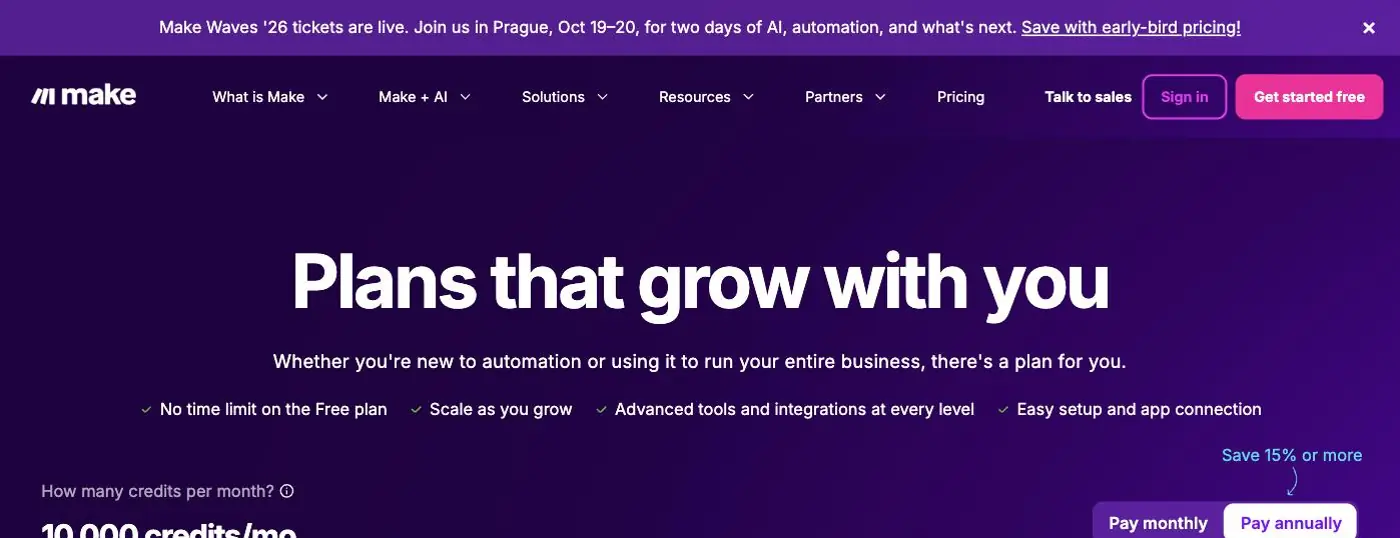
Prices checked against zapier.com/pricing and make.com/en/pricing as of August 2026; monthly (non-annual) billing runs roughly 15-30% higher on both platforms, so these annual figures aren't the sticker price you'll see by default on either site.
The unit names hide a real structural difference. A Zapier task is one action step firing once. A Make operation is roughly the same idea, one module executing, but Make's multi-step workflows are allowed even on the free plan, where Zapier's free plan restricts you to a single trigger and a single action. That's the bigger practical gap for anyone starting out: Make lets you build and test a real multi-step workflow for free, Zapier doesn't.
The two units also aren't equivalent at the same nominal volume, which is why a straight price-per-1,000 comparison is misleading: 10,000 tasks a month on Zapier's Professional plan costs $129/mo billed annually, while Make's Core plan covers 10,000 operations for $9/mo. That gap isn't Make being ten times more efficient, it's that Make's multi-step scenarios often collapse work into fewer counted operations than the same job takes in separate Zap steps.
Where Zapier still wins
App catalog size and polish. Zapier connects over 9,000 apps with generally deeper, more actively maintained integrations for mainstream SaaS tools. Make's catalog is smaller, and some integrations are community-built rather than officially maintained, which shows up as occasional gaps in less common apps.
Where Make usually wins
- Visual workflow builder. Make's canvas shows the full branching logic of a scenario at once; Zapier's linear step list hides branches inside collapsed paths.
- Price per unit of work. At equivalent volume, Make's credit pricing is consistently cheaper than Zapier's task pricing, largely because Make counts some multi-step logic as a single operation where Zapier would count each step.
- Free-tier usability. Covered above, multi-step on free is a real difference for evaluation.